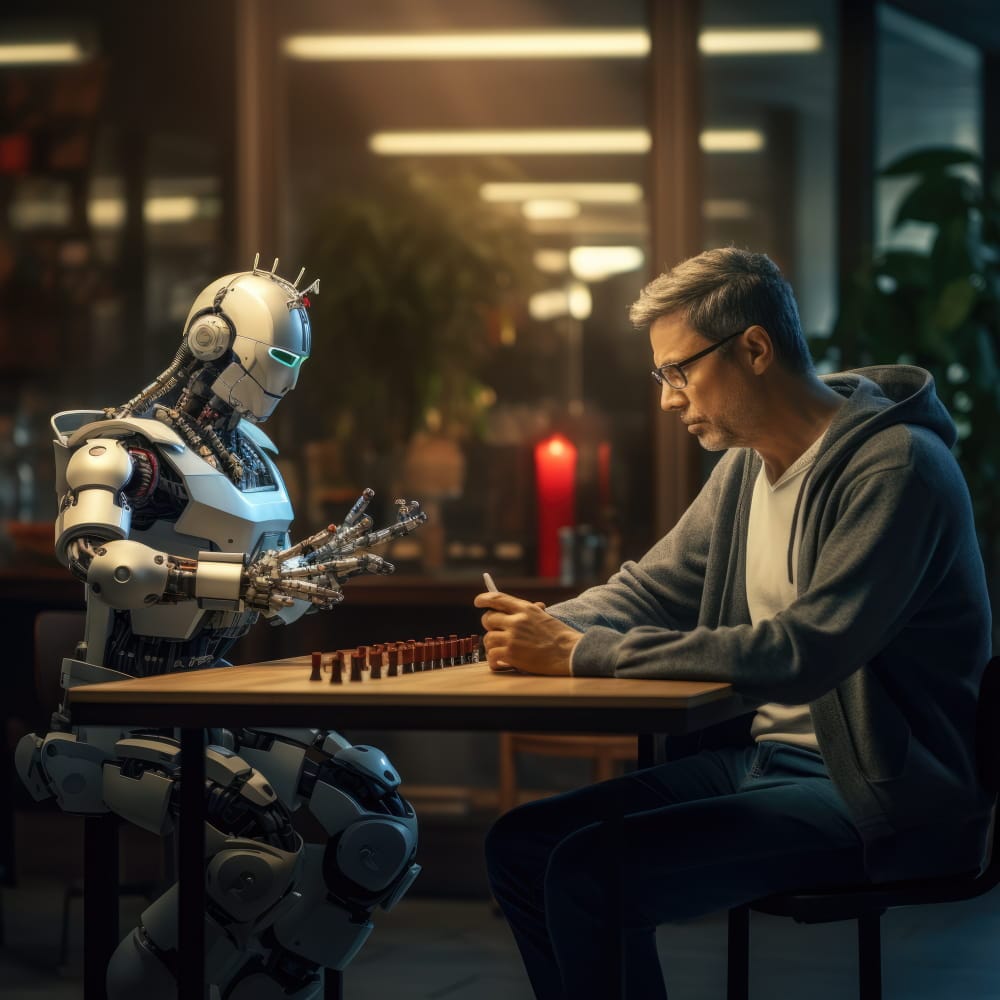
Generative AI reached 53% global population adoption within three years of ChatGPT’s launch, a rate faster than either the personal computer or the internet managed over a comparable period, according to the Stanford HAI AI Index 2026. That number has moved faster than most professionals expected, and for many, it has surfaced a question that wasn’t seriously on the table even three years ago: if AI can write, analyse, generate, and summarise, what exactly does a professional bring to the table that the tool cannot?
The answer to that question is not a list of soft skills, the kind that used to get mentioned politely in performance reviews and then never seriously developed. The World Economic Forum’s Future of Jobs Report 2025, which surveyed over a thousand of the world’s largest employers representing 14 million workers, is explicit that human-centred capabilities, specifically leadership, adaptability, critical reasoning, and social influence, are not declining in value alongside routine and technical skills, in fact they are rising.
For professionals serious about building careers that hold through the decade ahead, the NASSCOM-McKinsey projection of a shortage of 1.4 million AI professionals in India by 2026 is instructive in a specific way. The shortage is not of people who can use AI. It is of people who can direct it, evaluate its outputs critically, work across functions that AI cannot traverse alone, and exercise the kind of judgment that no model is trained to possess. That is the professional gap this piece addresses.
Before discussing the skills themselves, one clarification is worth making carefully, because the debate around AI and employment tends to conflate two separate questions: what AI can do, and what AI can replace. These are not the same thing.
What AI does well:
What AI structurally cannot do:
A 2026 analysis of 84 occupations across more than a hundred human skills, using O*NET occupational data, found that the capabilities consistently hardest for AI to replicate were not technical or domain-specific. They were interpersonal, ethical, and contextual, reflecting something structural about the difference between pattern-matching on historical data, which is what AI does extraordinarily well, and reasoning about situations that are genuinely new, ambiguous, or emotionally loaded, which is what most consequential professional decisions actually require.
AI performs best when the problem it is solving resembles problems it has encountered in its training data. When the situation is genuinely novel, when the rules are not defined and the available information is incomplete or contradictory, AI’s performance degrades significantly.
In a professional environment, this kind of ambiguous judgment shows up constantly:
These are not edge cases. They are the routine reality of senior professional work, and precisely the kinds of decisions where relying too heavily on AI output without human evaluative judgment carries the highest risk.
Emotional intelligence remains one of the capabilities that researchers across multiple disciplines consistently identify as structurally resistant to AI replication, not because AI cannot simulate emotional language, which it can do quite convincingly, but because genuine emotional intelligence involves accurately perceiving what another person is feeling in real time, drawing on cues that are subtle, contextual, and often non-verbal, and then responding in a way that serves both the relationship and the task at hand.
A Workday global survey found that 83% of employees believe AI will make uniquely human skills more critical and emotional intelligence sits at the top of that category consistently across employer surveys and occupational research.
For professionals, this matters in very practical terms across common professional situations:
Managing a workforce that is itself adapting to AI-assisted work, with all the anxiety and uncertainty that transition brings, requires emotional attunement of a kind that cannot be delegated to a platform. This skill becomes more consequential, not less, as organisations adopt more AI.
AI can draft a communication. What it cannot do is decide whether the communication is the right one for this particular audience, at this particular moment, given what happened in the last meeting and the broader relationship history that only a human professional who has been in the room would know.
Complex communication, the kind that actually changes minds, resolves conflict, or moves a group of people toward a decision they were reluctant to reach, is not a writing task. It is a judgment task that happens to express itself in writing. This distinction matters significantly across professional situations involving:
The words a leader chooses when announcing an organisational change, the tone of a difficult client conversation, the sequencing of a persuasion strategy across multiple meetings, all of these draw on an understanding of people and politics that is deeply specific to the people and organisation involved, and therefore largely inaccessible to any general-purpose AI tool.
AI reflects the biases baked into its training data, and someone has to make the call on whether an AI recommendation is fair, legal, and appropriate for the specific context, which is not a nice-to-have skill but is becoming a job requirement.
As AI is embedded into consequential decisions across organisations, the question of who is accountable for the ethical quality of those decisions becomes more urgent, not less. The domains where this is already live include:
AI does not possess ethical judgment. It produces outputs that are probabilistically plausible given its training data, and those outputs can carry significant harm if applied without human evaluation.
The WEF Future of Jobs Report 2025 identifies leadership and social influence as among the top rising skills globally, pointing to something more specific than seniority or title: the ability to inspire trust, create alignment across people with different interests, and motivate sustained effort toward goals that are sometimes uncomfortable or unclear, none of which scales through AI.
Trust, in particular, is built through:
A team’s trust in its leadership is not a metric that can be optimised algorithmically. It is a relationship outcome that depends entirely on the quality of human behaviour over time, and for professionals managing increasingly diverse, multi-generational teams, it has specific relevance in a context where younger employees expect transparency and genuine dialogue in ways that older command-and-control leadership styles do not accommodate.
There is a meaningful difference between AI-assisted creativity, which involves generating variations on existing patterns at high volume and speed, and original problem-framing, which involves recognising that the problem being solved might be the wrong problem, and that the question itself needs to change before the answer can be useful.
A 2025 analysis noted AI’s inability to replicate the judgment required for innovation, where experience and intuition guide breakthroughs, because while AI generates prototypes based on historical trends, humans refine concepts by anticipating cultural shifts or user needs beyond data patterns.
In professional practice, original thinking tends to surface in ways AI cannot reach:
AI can support and accelerate this kind of thinking once a direction is set, but it cannot originate the direction itself.
The WEF identifies resilience, flexibility, and agility as among the most critical human capabilities for the period ahead, alongside curiosity and lifelong learning, and it is worth being precise about what adaptability actually means in a professional context, because it is frequently discussed in vague terms that obscure its practical content.
Adaptability in the AI era is not simply a willingness to learn new tools. In practice, it involves:
In an environment where 39% of core skills will change by 2030 and in India’s demand for AI-linked roles is expected to grow by over 30% in 2026 alone, the professionals who treat learning this way will hold an advantage that compounds over time. The India Skills Report 2026 notes that overall graduate employability has risen to 56.35%, but a significant portion of that improvement is concentrated in sectors and candidates already engaged with digital and AI-adjacent skills. The gap between those actively building future-relevant capabilities and those waiting for formal systems to catch up is widening, and adaptability is what determines which side of that gap a professional lands on.
The framing of human skills versus AI treats the two as competing in the same category of work, which misrepresents both. AI tools, even highly capable ones, are instruments. They do not have interests, do not bear accountability, do not build relationships, and do not exercise judgment. They produce outputs, and those outputs require human professionals to evaluate them, contextualise them, take responsibility for their use, and decide when to trust them and when to question them.
Deloitte’s 2025 Human Capital Trends report found that organisations investing in workforce development were 1.8 times more likely to report better financial results, and the investment that compounds most over time is not in technical AI literacy alone, but in the combination of AI literacy with the human capabilities that allow a professional to deploy it intelligently.
The professional who can use AI effectively and evaluate its outputs critically, who can lead people through the uncertainty that AI-driven change produces, and who brings the ethical judgment to catch what the model gets wrong, is not competing with AI. They are the reason AI produces value rather than risk in a given organisation.
For example, India recorded 290,000 AI-linked job roles in 2025, with demand expected to grow by over 30% in 2026, and the structural implication of that growth is not that human skills matter less but that the ceiling for professionals who combine strong human capabilities with AI competency is rising faster than the ceiling for either alone. The same situation exists across the world.
The professionals who will hold the most durable positions across this decade are not those who avoid AI out of scepticism, nor those who adopt every tool uncritically. They are the ones who understand where AI adds genuine value, where it needs human oversight, and where it cannot be trusted to operate independently, and who bring the reasoning, communication, leadership, and ethical judgment to make those calls correctly, consistently, over time. These are not peripheral skills. They are, increasingly, the point.
The direct answer is NO. The World Economic Forum’s Future of Jobs Report 2025 projects that while automation will displace certain roles, approximately 97 million new jobs requiring distinctly human skills will emerge by 2030. AI replaces repetitive, rule-based tasks. It cannot replicate ethical judgment, contextual reasoning, leadership, or emotional intelligence.
According to the WEF Future of Jobs Report 2025 and independent occupational research, the most important human skills in the AI era are critical thinking, emotional intelligence, complex communication, ethical reasoning, leadership and social influence, original problem-framing, and adaptability. These are consistently the hardest skills for AI to replicate because they are interpersonal, contextual, and ethical in nature.
No. AI literacy is necessary but not sufficient. Deloitte’s 2025 Human Capital Trends report found organisations investing in human-centred development were 1.8 times more likely to report better financial results. Future-proof skills for professionals are built at the intersection of AI competency and human capability.
The biggest advantage humans have over AI is genuine judgment in novel, ambiguous, or ethically complex situations. AI performs well on problems resembling its training data. When a situation is new, politically sensitive, or requires reading what is not being said aloud, AI’s performance degrades significantly.